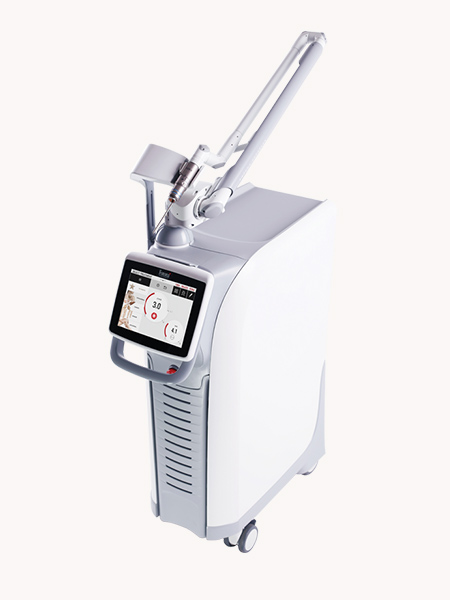
What Is Fotona StarWalker Toning?
StarWalker toning is a procedure that manages melasma, blemishes, and skin tone by using the principle that laser energy is absorbed by pigment in the skin. Because the type and depth of pigment can differ even within a single face, the wavelength, intensity, and energy delivery method are adjusted by area.
A distinction is made between pigment that requires repeated management, such as melasma, and localized blemishes. A lesion with an unusual shape or color may require a separate examination before toning is started.
What Are Picoseconds and Nanoseconds?
Picoseconds and nanoseconds are units representing the extremely short time over which a laser delivers energy. A picosecond is one trillionth of a second, and a nanosecond is one billionth of a second.
StarWalker’s pulse technology delivers short picosecond micro-pulses carried within nanosecond-scale energy packets. It acts on pigment by combining a brief moment of high output with sufficient pulse energy.
Treatment outcomes are not determined by pulse duration alone. Wavelength, intensity, the type of pigment, and skin sensitivity must all be considered together.
How Is It Different from Pico Toning?
Pico toning refers to pigment-management procedures using a picosecond laser. StarWalker is distinguished by its approach of combining picosecond micro-pulses with nanosecond energy delivery. Its pulse structure is not the same as that of a dedicated picosecond laser, and which approach is suitable depends on the pattern of melasma or blemishes and the skin’s response.
If you are considering pico toning, please let us know the type and number of previous laser treatments you have received, along with their effects and any irritation responses. The toning method is chosen together based on your current skin condition.
Who Is It Suitable For?
- Those concerned about both melasma and blemishes together
- Those with uneven skin tone or dull-looking skin due to pigmentation
- Those who wish to consistently manage recurring melasma
- Those who want to check the effects or irritation response from a previous toning session and adjust the approach
- Those who wish to consult about skin texture and pore condition together with pigmentation
Please Let Us Know Before the Procedure
Please let us know if you have recently been exposed to strong ultraviolet light or have sunburned skin, or if there is inflammation, infection, or herpes at the treatment site. We will also check for pregnancy, medications and photosensitivity reactions, a history of keloids, and any experience of post-inflammatory pigmentation after previous laser treatment.
How Does It Work?
When laser energy is absorbed by pigment, it acts on the pigment particles. The 1064nm and 532nm wavelengths are selected according to the pattern of pigment and skin condition, and intensity and repetition count are adjusted by area.
Toning is a method of repeatedly managing pigment and skin tone over a wide area. Different settings may be used when treating localized blemishes, and any procedures needed for pores, skin texture, or scars are determined separately.
When Do Effects Begin to Show?
With toning, some people notice a change in skin tone after 3–5 sessions, and treatment is generally planned with a reference of 5–10 sessions at 2–4 week intervals. The number of sessions and interval vary depending on skin response and the type of pigment.
For localized blemishes, a change may be visible after a single session, but progress should be checked after any scab has subsided. Because melasma can be affected by factors such as ultraviolet light and hormones and may recur, sun protection and maintenance care are important.
Recovery and Precautions
After toning, redness or flushing may remain for about 1–2 days, and in some cases irritation responses such as folliculitis or small pimples may occur. The speed of recovery varies depending on skin condition and treatment intensity.
If blemishes were treated locally or stronger settings were used, redness and fine scabbing may remain for about 3–7 days. Please do not forcibly remove any scabs, and continue moisturizing and sun protection. Please avoid exfoliants, scrubs, and irritating cosmetics until the skin has stabilized.
Please inform the clinic if you experience blistering or oozing, worsening pain, prolonged redness, or a change in which the skin turns white or the pigment becomes darker.
How WayB Approaches This
- We check your previous laser experience, including pico toning, and your skin’s response.
- We plan the procedure by examining the type and distribution of pigment, along with redness and sensitivity.
- Rather than applying strong stimulation all at once, we adjust intensity and interval according to how your skin responds.
- We take into account UV exposure and any important schedule, and check the changes together after the procedure.