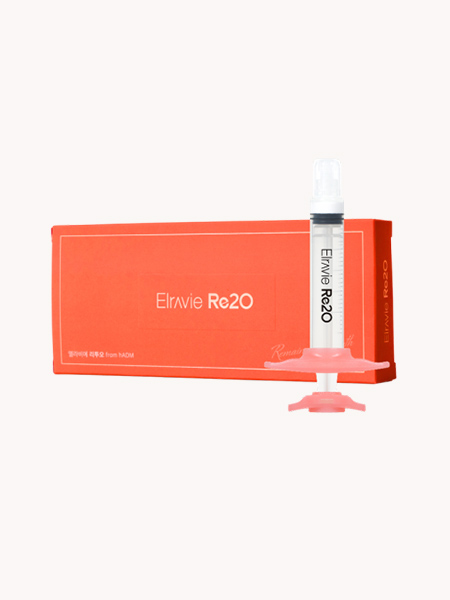
What Is Re2O?
Re2O (Elravie Re2O) is a treatment that uses a material processed from human-derived acellular dermal matrix (hADM) into fine particles. Its purpose is to replenish extracellular matrix (ECM) components—such as collagen and elastin—that support the skin, helping to manage skin texture and elasticity.
The ECM is a structure that supports tissue between the skin’s cells. Re2O is a product that focuses on the components making up this structure; it is manufactured by L&C BIO and supplied by Humedix under the Elravie brand.
Because a human-derived material is used, the origin and characteristics of the material, along with the expected changes and side effects, are explained before the procedure. Whether the treatment is suitable is determined by checking skin thickness, elasticity, the area of concern, and prior treatment history together.
What Are Its Features?
ECM Components That Make Up the Skin
Re2O contains dermal extracellular matrix components such as collagen, elastin, and glycosaminoglycans (GAG). Collagen is related to the structure that supports the skin, elastin to the skin’s elasticity, and GAG to the environment that retains moisture.
A Material Utilizing Acellular Dermal Matrix
Donated human dermal tissue is processed to remove cellular components, leaving the ECM to be used. This is not a treatment that injects living cells or stem cells.
Care That Supports the Skin with ECM Components
Re2O replenishes the components that support the skin. It may be considered when skin texture, fine lines, and elasticity are concerns together; rather than expecting the same result for every skin concern, it is important to set the care goal that is needed.
Who Is It Suitable For?
- Those who feel their skin has become thinner along with reduced elasticity
- Those concerned about fine lines together with rough skin texture
- Those with visible pores and an uneven skin surface
- Those reassessing their skin condition after previous treatments and considering other care options
If scars are deep or indentation is pronounced, scar treatment or volume-restoring procedures may be more suitable. Sagging, melasma, and pigmentation likewise require separate treatment depending on their cause.
Please Let Us Know Before the Procedure
Please inform us during your consultation of any inflammation or infection at the treatment site, allergy history, autoimmune disease, any immunosuppressive treatment, pregnancy or breastfeeding status, and medications you are taking. Please also let us know about any recent filler, skin booster, or laser treatments, and whether you experienced severe swelling or nodules after past procedures.
How Does It Work?
The dermal ECM is a component that supports skin tissue and forms the environment in which cells function. As this structure changes due to aging, UV exposure, and other factors, changes may also appear in skin texture and elasticity.
Re2O replenishes the ECM components contained in hADM and helps improve skin texture and elasticity through the surrounding tissue’s response. Actual changes vary depending on skin condition, the area treated, and the treatment method. Deep scars or pronounced indentation may require separate treatment.
How Is It Different from Other Skin Boosters?
Even under the same name of “skin booster,” the composition and method of application differ. Rather than the superiority of a particular product, the choice is made based on the current skin condition and your goals. Characteristics may also differ between products within the same category.
When Do Effects Begin, and How Long Do They Last?
Swelling and redness may occur right after the procedure, making it difficult to judge the final result from the immediate visible difference. After the initial reaction subsides, changes in skin texture and elasticity are observed over the following weeks.
At WayB, 3–4 sessions at about 1-month intervals are considered as a basic plan, with the number of sessions adjusted according to skin condition and post-procedure response. Even after repeated treatments, a consistent effect or duration is not guaranteed, and additional sessions are decided after reviewing progress.
How Is the Safety of the Material Managed?
According to the manufacturer’s materials, donor suitability evaluation, infection-related testing, tissue processing and sterilization, and product traceability are carried out. The manufacturer, L&C BIO, is registered as an AATB-accredited tissue bank.
Separately from this management, the possibility of infection, inflammation, hypersensitivity reactions, or nodules after the procedure still exists. In addition to the characteristics of the material, checking skin condition before the procedure and monitoring progress afterward are also important.
Recovery and Precautions
- Redness, swelling, bruising, tenderness, and small temporary raised bumps may appear after the procedure. Swelling may persist for about 7 days, so if you have an important schedule, it is best to allow room for recovery. Depending on the area, treatment method, and skin condition, it may persist longer.
- Light face washing is generally advised about 3–4 hours after the procedure, and makeup from the next day, adjusted according to skin condition.
- Please avoid saunas, steam rooms, and excessive exercise for about 1 week.
- Do not press or rub the skin strongly, and do not massage areas where a lump is felt without your medical provider’s instruction.
- Moisturize sufficiently and use sunscreen when going outside. Resume exfoliation and use of irritating cosmetics only after the skin has stabilized.
- The interval before other procedures is determined after checking your recent treatment history and recovery status.
Please Contact the Clinic If
- Swelling does not subside even after about 7 days, or recovery is slow
- Redness or swelling keeps worsening regardless of elapsed time
- A firm lump or uneven bumpiness persists or newly appears
- Pain or a feeling of heat worsens, or is accompanied by discharge or fever
If symptoms rapidly worsen, please contact us right away rather than waiting out the period. If difficulty breathing or severe swelling of the lips or tongue occurs, seek emergency care immediately.
How WayB Approaches This
- We review the cause of reduced skin texture and elasticity to check whether Re2O is a suitable choice.
- We explain the origin and characteristics of the human-derived material, the expected changes, and other options.
- We adjust the area of application and injection method according to skin thickness and area of concern.
- We fine-tune anesthesia and injection speed to reduce discomfort during treatment.
- We check prior treatment history and recovery status to determine the interval and order of repeated treatments.